

Quick reminder: early voting in North Carolina will be open until 3pm this Saturday, February 28, 2026. If you’re in North Carolina, please make a plan and vote!
Since there are judicial candidates on the primary ballot at every level except for the North Carolina Supreme Court--and the Supreme Court seat will be on the ballot in November--I thought we could start with a quick primer on the structure of the North Carolina state courts.
The North Carolina judicial branch is a creature of our state constitution, much like the federal judiciary is a creature of the U.S. Constitution. Article IV of the N.C. Constitution governs the state courts, terms of office, qualifications, and so forth. It’s a pretty short read if you’re curious: https://www.ncleg.gov/Laws/Constitution/Article4.
The N.C. Constitution creates four different courts within the General Court of Justice, the official name for the North Carolina unified court system which came to exist in 1966. I’ll spare you the details today, but before the unified court system, North Carolina had a patchwork of local court systems that frequently created inconsistent rulings and countless headaches for lawyers and the public alike. Some called it the “crazy quilt” era. Decades of activism eventually led to a constitutional amendment and our current court system.
Today, the state constitution creates four courts, two appellate courts and two trial courts. These include the District Court and the Superior Court, both trial courts, as well as the Court of Appeals and the Supreme Court, both appellate courts.
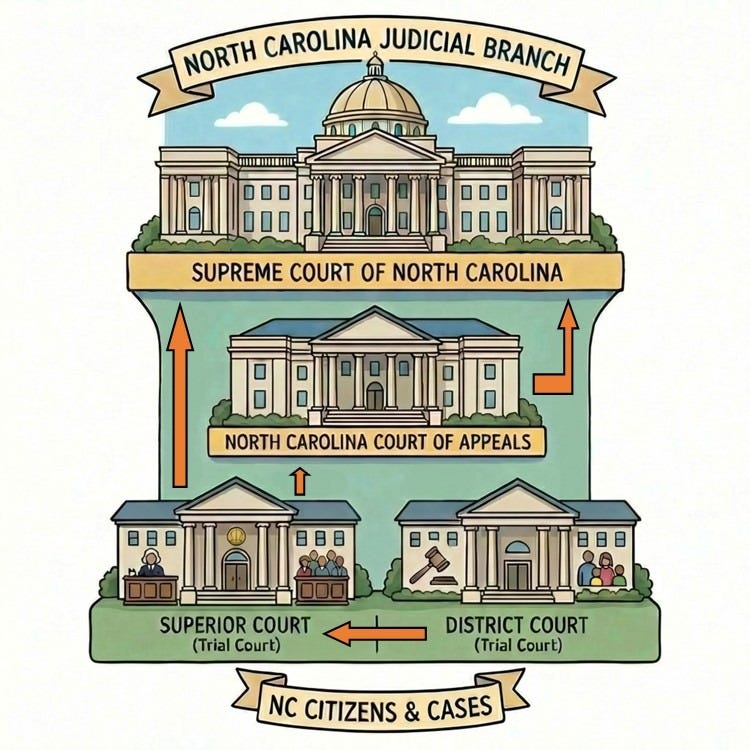
Supreme Court
The Supreme Court is the state’s highest court and is the final court for all disputes arising under state law. In some limited instances, cases may be appealed from the state Supreme Court to the U.S. Supreme Court, but these usually involve federal matters or the U.S. Constitution.
The state Supreme Court has seven justices -- a Chief Justice and six associate justices. All justices are elected to eight-year terms. They hear and decide cases together which have been appealed from lower courts, usually the Court of Appeals.
The Supreme Court does not have a jury. Instead, it considers only questions of law. In other words, it resolves disputes over the correct interpretation and application of the law. It does not make factual decisions, and instead generally relies on the factual decisions from the lower courts.
Court of Appeals
The Court of Appeals is an intermediate appellate court that hears the vast majority of appeals from the trial courts. As an appellate court, it generally relies on the factual decisions from the trial courts and focuses on the correct interpretation and application of the law.
The Court of Appeals has 15 judges who sit in panels of 3 judges, randomly assigned for each case, to hear and decide those cases. One of the judges also serves as the Chief Judge of the Court of Appeals, mostly for administrative purposes, and that position is appointed by the Chief Justice of the Supreme Court. Judges on the Court of Appeals are elected to eight-year terms.
Very few cases are accepted for consideration at the Supreme Court, so as a practical matter, the Court of Appeals is also usually the last court to hear and decide legal questions related to state law matters in North Carolina.
Superior Court
Superior Courts are trial courts which handle cases from the filing of a complaint or indictment through the entry of a judgment and sentencing. This includes overseeing the discovery process in early litigation, deciding certain legal issues early in a case to narrow the issues for a jury, empaneling a jury to hear the case to determine the facts, and then as necessary, applying those facts to reach a judgment.
The Superior Court hears cases involving felony crimes, civil cases involving $25,000 or more, and appeals from the District Court. Superior Court judges are elected to eight-year terms.
District Court
Like the Superior Courts, District Courts handle certain cases from start to finish, including jury trials to determine the facts of a case. District Courts handle misdemeanor cases and civil cases involving between $10,000 - $25,000.
District Courts handle most family law matters, including divorce and child custody proceedings. District Court judges are elected to four-year terms.
Reminder!
In North Carolina, there are five names to watch for state-wide judicial races:
Supreme Court:
Justice Anita Earls
Court of Appeals:
Judge John Arrowood
Judge Toby Hampson
Open Seat -- Primary Candidates: Christine Walczyk and James Whalen
Until next week’s primary is complete, we have included Justice Earls and Judges Arrowood and Hampson in our 2026 NC Judicial Slate. Next week, we’ll add the winner of the primary contest for the open seat to the slate. Please consider supporting these deserving candidates. Every contribution helps, no matter the size!
