

Over the next several weeks, we’ll look back at some of the recent partisan gerrymandering cases from North Carolina that directly impact our state’s political maps today. But first, let’s make sure we are on the same page as to what exactly we are talking about with partisan gerrymandering.
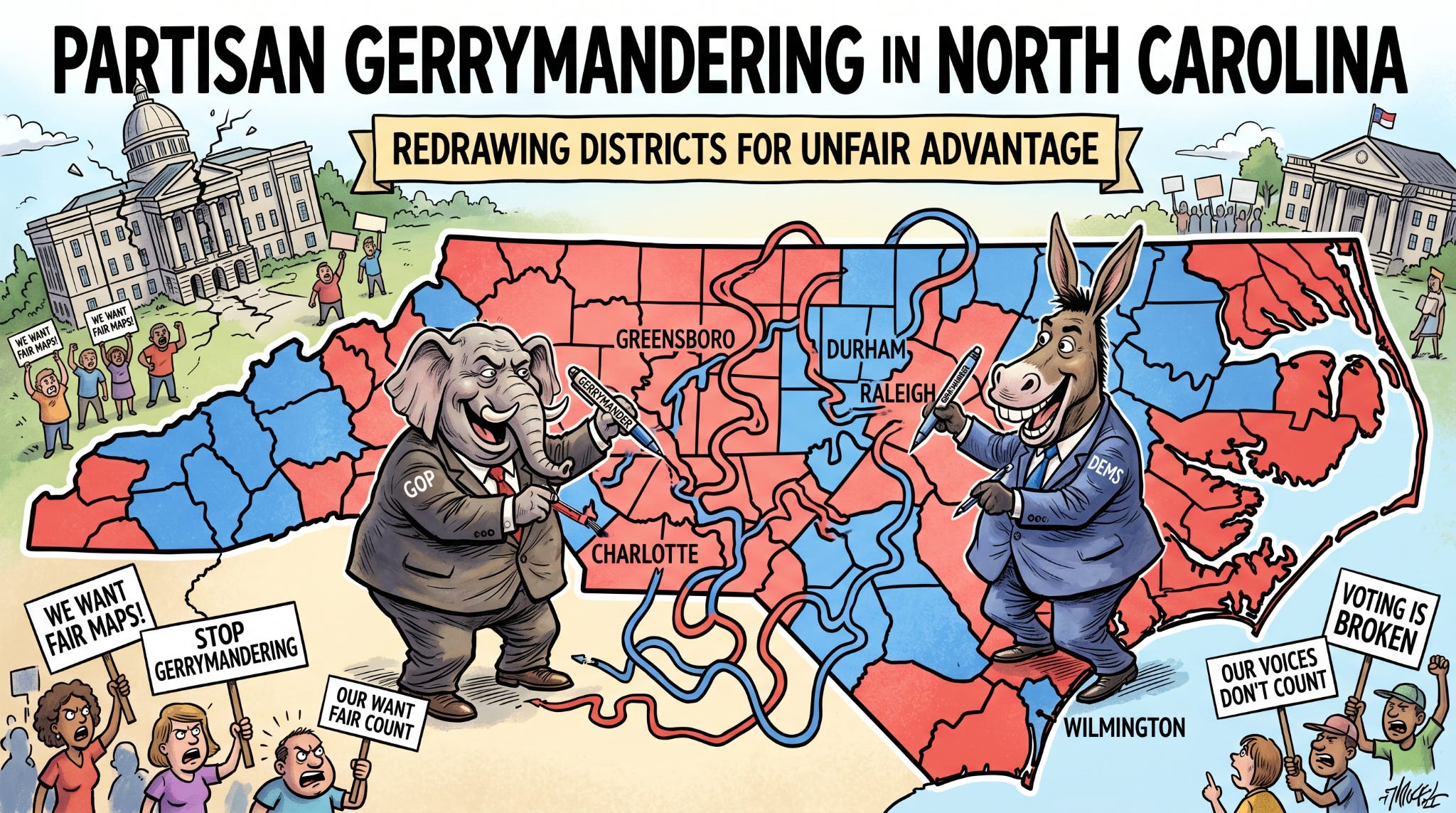
What Is Partisan Gerrymandering?
Partisan gerrymandering is the manipulation of electoral district boundaries to give one political party an advantage.
Every ten years, after the U.S. census, states redraw congressional and legislative district maps to reflect population changes.1 Ideally, this process—called redistricting—ensures fair representation. But when the party in power controls map-drawing, they can deliberately design districts to tilt elections in their favor. This practice is known as partisan gerrymandering. Partisan gerrymandering has been around for centuries, but it undermines the principle that voters should choose their representatives, not the other way around.
How It Works
Two common tactics define partisan gerrymandering:
Packing: Concentrating the opposing party’s voters into a few districts, ensuring they win overwhelmingly there but lose influence elsewhere.
Cracking: Splitting the opposing party’s voters across many districts, diluting their power so they can’t form a majority.
For example, if a state has an even split between Party A and Party B, Party A might redraw maps so that Party B wins only a small fraction of seats despite having nearly half the voters.
Several years ago, The Washington Post ran an article that used the visual below, adapted from a Facebook post later attributed to Stephen Nass. While this is an extremely simplified example, it is also quite useful for demonstrating some basic redistricting terms. You can read the full article here.

In this example, we have 50 people--20 red, 30 blue--and we need to form 5 equal districts. To make the example easier, these people have sorted themselves quite neatly into red and blue groupings. Historically, this rarely happens, although recently it has become more realistic with the rural / urban divide between the Republican and Democratic parties, respectively.
Example 1, called “perfect representation” above, is often called “proportional representation” in real life examples.
Example 2 introduces the terms “compact” and “unfair,” which I explain below, and it results in a clean sweep for blue. This is a partisan gerrymander in favor of blue.
Example 3 is also a partisan gerrymander, but this time for red. It uses both “cracking” and “packing” techniques to create two overwhelmingly blue districts (think Charlotte or Raleigh) and three majority red districts (most everywhere else in North Carolina).
Now for the terms--compact simply means a tightly drawn district. A circle would be a perfectly compact district with all edges equidistant from the center. A square would also be a very compact district. Meanwhile, a long, narrow, twisty district is not at all compact.
“Fair” is more complicated. Some people believe proportional representation for an entire state, or other voting group (city, county, etc.), is fair. However, proportional representation can be achieved through an equal split of districts that are highly gerrymandered and all but guaranteed to result in a Republican and Democratic win. See Example 1 above. While this may result in an equal split of Republican and Democratic representatives, it still leaves the voters with no meaningful choice in the general election.
Others, including Carolina Democracy, believe maximizing competitive districts is the better definition of fair. However, I’ll freely acknowledge the drawback here is that during a wave election, it’s conceivable that a 50-50 state, with all perfectly competitive districts, could result in a single party taking all of the seats. Certainly not ideal, but staggered terms for representatives can help lessen the impact of wave elections (think U.S. Senate or state courts).
The reality is that drawing perfectly proportional or perfectly competitive districts is nearly impossible given the random distribution of where people live and fluctuating preferences between political parties. Some urban districts will be Democratic, and some rural districts Republican, no matter how you draw them in North Carolina.
However, 2022 showed us that we can have both proportional representation and at least some competitive districts. Under the maps used in 2022, North Carolina sent 7 Republicans and 7 Democrats to the U.S. House. Many districts were foregone conclusions by the general election, but several were at least somewhat competitive.
By 2024, North Carolina reverted to a severely gerrymandered map, resulting in a 10-4 Republican/Democratic delegation. In 2026, with an even further gerrymandered map, Republicans hope to push the North Carolina delegation to 11-3 Republican/Democratic.2 Only one district is even remotely close to competitive, and the other 13 are all but decided.
Why It Matters
Partisan gerrymandering distorts democracy in several ways:
Unfair representation: Legislatures may not reflect the actual political makeup of the population.
Reduced accountability: Safe districts discourage competition, allowing incumbents to ignore voter concerns.
Polarization: Politicians in gerrymandered districts often cater to extreme bases rather than moderates, deepening divides.
Legal and Political Debate
The U.S. Supreme Court has explicitly rejected partisan gerrymandering claims under the U.S. Constitution. Next week we will review that case which originated out of North Carolina. Then we will look at the recent North Carolina Supreme Court decisions first barring, and then flipping to allow, partisan gerrymandering under the North Carolina Constitution. Stay tuned!
p.s. — Don’t forget to support our rockstar Democratic judicial candidates via our 2026 NC Judicial Slate!

Redistricting should only happen once per decade. In the last couple decades, North Carolina, and lately many other states, have found reasons to redistrict much more frequently.
Again, redistricting should only happen once a decade. North Carolinians have voted under a new Congressional map every election for at least the last four elections.