

Several weeks ago, we looked at the trial court decision of Rucho v. Common Cause. A bi-partisan 3-judge panel conducted a full trial and found that the North Carolina 2016 congressional map violated the First Amendment, Equal Protection Clause (Fourteenth Amendment), and various provisions of Article I of the U.S. Constitution.
However, Republicans in the N.C. General Assembly appealed this decision to the U.S. Supreme Court. The Supreme Court then overturned the trial court and held that federal courts do not have the power to review partisan gerrymandering claims.
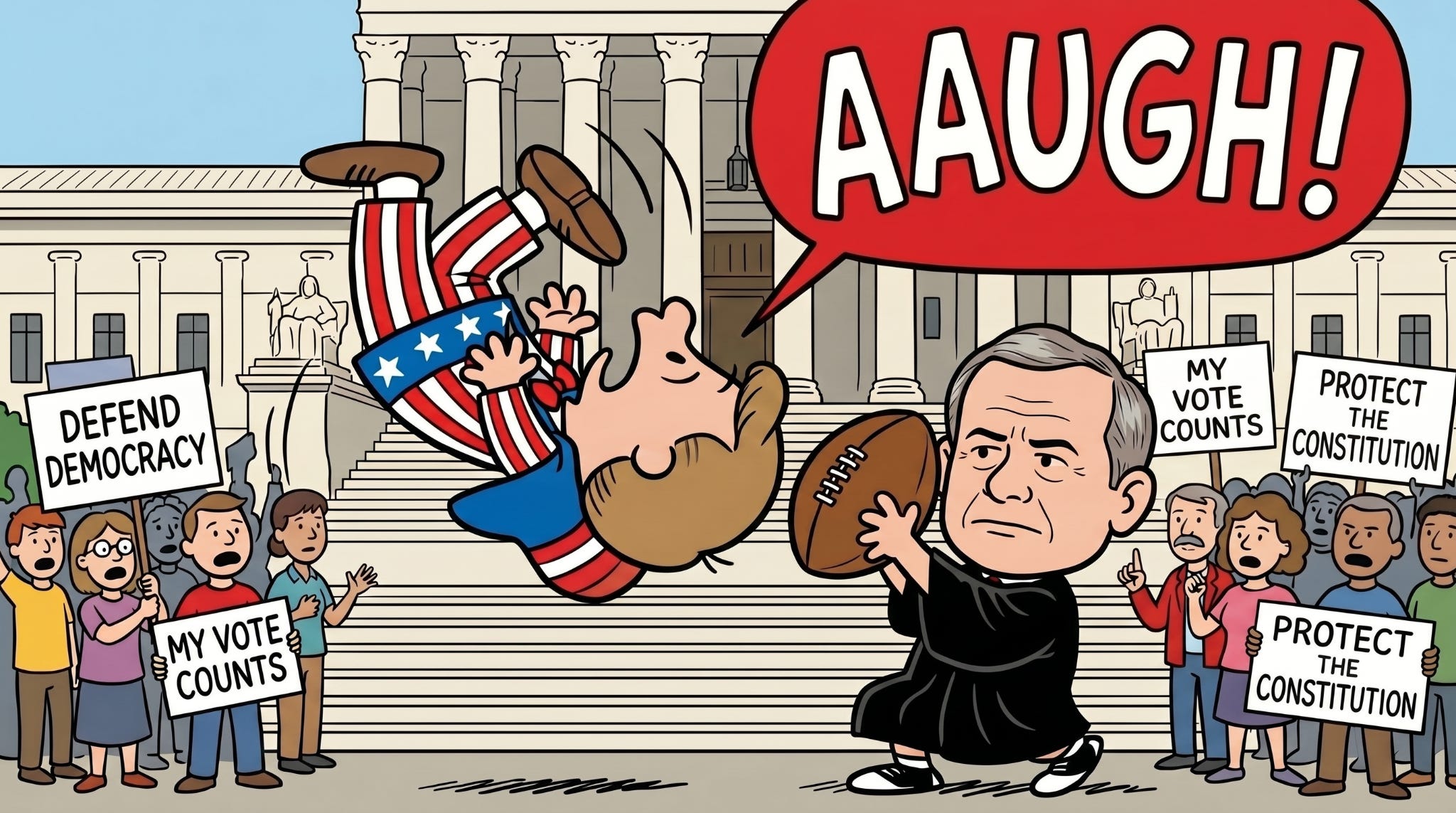
Here’s the short version:
First, a bi-partisan, 3-judge panel in North Carolina concluded that North Carolina’s 2016 Congressional map was unconstitutional because it inverted the fundamental republican principle that voters choose representatives, not the other way around.
That trial court found the map was deliberately drawn to disadvantage a politically identifiable group (Democrats), producing predictable, durable partisan entrenchment (for Republicans) without any legitimate state interest to justify that discrimination.
Next, the case proceeded to the U.S. Supreme Court. Chief Justice John Roberts, writing for the majority, lamented that partisan gerrymandering is “incompatible with democratic principles.” However, the majority threw up their hands and claimed they were powerless to do anything about partisan gerrymandering.
In other words, while they said partisan gerrymandering is really bad, policing it is not their job.
Longer version:
In 2019, Chief Justice Roberts, joined by Justices Thomas, Alito, Gorsuch, and Kavanaugh, ruled that partisan gerrymandering claims are nonjusticiable political questions in federal courts.
The Court observed that partisan gerrymandering may be “incompatible with democratic principles,” but held that federal courts cannot adjudicate partisan gerrymandering claims because there are no manageable standards to decide when partisan advantage in redistricting becomes unconstitutional.
Instead, the Court said partisan gerrymandering must be addressed by state legislatures or Congress, not the courts.
Ironically, the Court also went out of its way to distinguish partisan gerrymandering from racial gerrymandering. It claimed that racial gerrymandering was still unconstitutional and subject to clear constitutional and statutory standards. As other recent decisions have shown, this was just another Lucy holding the football.
Also notable, Justice Kagan, joined by Justices Ginsburg, Breyer, and Sotomayor, dissented and argued that extreme gerrymandering violates fundamental democratic principles. She believed that courts have both the authority and responsibility to intervene.
Justice Kagan recognized that gerrymandering entrenches one party in power, distorts representation, and deprives voters of equal influence. She also pointed to several manageable standards for measuring extreme partisan gerrymandering. In reality, using the exact same statistical methods and tools that produce extreme political maps in the first place, it’s actually pretty easy to measure partisan gerrymandering and set limits.
In reality, this is nothing more than a math problem, and the dissenters recognized we need to set limits to protect our democracy and the will of the people. In contrast, the majority said not our job, we don’t do math.
Following the Rucho decision, the North Carolina Supreme Court initially found that extreme partisan gerrymandering violates the North Carolina Constitution. However, after Republicans took the majority on the N.C. Supreme Court, they quickly reversed this and several other important democracy related holdings. But more on that next time!
In the mean time, please don’t forget to support our rockstar Democratic judicial candidates via our 2026 NC Judicial Slate! Electing judge who will protect and defend our basic democratic values is key to all future democratic success in North Carolina!

NO gerrymandering should be allowed anywhere! It has to be be unconstitutional to not allow voters to choose their representatives who should not be allowed to choose their voters. 😡😡💙💙💙